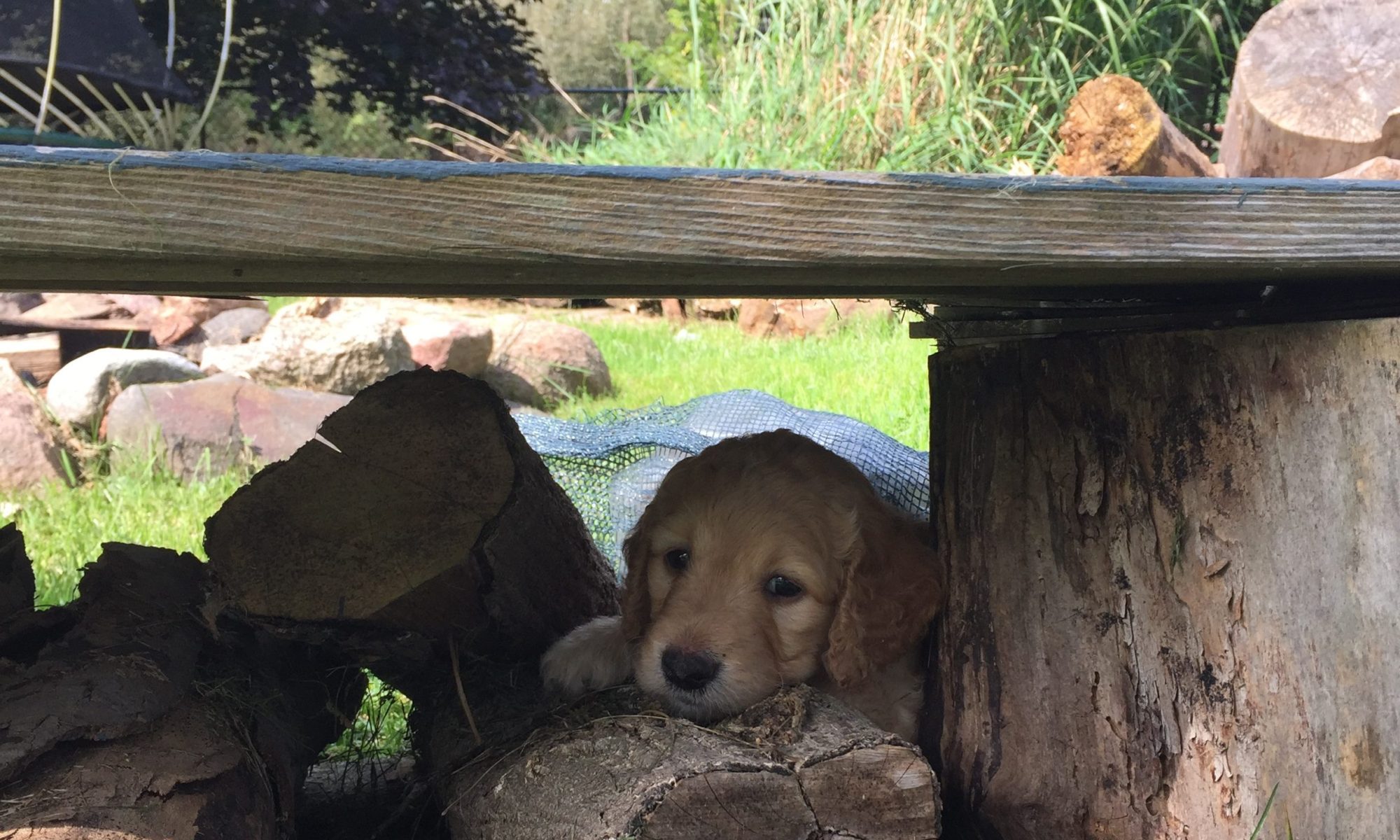
Look at how adorable Piper’s three week old puppies are

Pipers’ adorable puppies are now three weeks old and have progressed rapidly this week. The puppies have grow bigger with each passing day, their eyes have fully opened, and their vision is improving.The puppies’ ears have also opened and now react to sound. 

Piper’s puppies are becoming more aware of their surroundings and have started playing with each other during their brief “awake” periods. During this time, they get quite noisy as they practice vocalizing. However, they still sleep most of the day and night.

Puppy Culture

This week the puppies were in the Transitional Period. We continued our ENS exercises which cause tiny stresses to benefit our puppies with greater tolerance to stress, greater resistance to disease, faster adrenal system, stronger heart rate and stronger heartbeat. Friday was Day 16 of the puppies life and the final day for our ENS exercises.

Critical Socialization Period (weeks 3 – 12)

The next period for Piper’s puppies is the Critical Socialization Period. We know that puppies have entered into this period when the react to sounds. We raise our puppies following many of the Puppy Culture protocols. These protocols helps us reach our goal “To Raise Healthy, Calm, Confident, Well-Adjusted Puppies“.

Over the remaining weeks we will be working on new experiences for the puppies by exposing them to as many new experiences as possible in order to raise the best possible companion for their forever families.

Emotional Intelligence 

Because Goldendoodles are companion dogs, it is important to teach emotional intelligence from young puppies and start them on a great beginning. With this intention we follow 7 key things that will nurture the emotional intelligence of a puppy.

  1. Communication – giving a puppy his own voice i.e. Communication Trinity: power up clicker, box game, manding and attention/distraction protocols
  2. Emotional stability – the ability to recover easily from fear as well as stress i.e., startle recovery, barrier challenges etc
  3. Habituation – familiarize the puppies with the maximum number of things during their Critical Development Period. In particular, Puppy Parties, sound protocols, household noises as well as meeting different people and dogs.
  4. Enrichment – teach the puppies that novelty and challenges are opportunities for enrichment not things to be feared or avoided. For example, ongoing introduction of new novelty items, activity centre, car ride, outdoors, etc.
  5. Health – physical wellness and motor skills that will allow the puppy to develop in a neurologically and physically sound way . For instance, daily weight checks, grooming, proper nutrition, fecal checks, and deworming, if necessary, vet health checks and vaccinations)
  6. Skills – learned behaviors which teach the puppy to function in human society i.e. recall, manding, simple commands, potty box training, crate introduction, resource guarding, bite inhibition etc.
  7. Love – teach puppies to seek out the company of both dogs and humans as emotionally positive experiences: i.e., Daily cuddles with humans and puppy’s mom.
  8. Shaping emotional responses: happy and calm CER (Conditioned Emotional Responses). For instance, treats and encouragement during puppy training.

Puppy Cuddles

The puppies had a visit this week from some of my grandchildren. I am blessed with fifteen grandchildren who love to cuddle puppies. This interaction is very beneficial for the puppies as they are introduced to people of all ages.

Starting Potty Training

  • Now that the puppies can void on their own, they have an instinct to move away from their sleep area to go potty. To encourage the puppies to “go in one spot, “ we have divided the whelping box into a sleep/play area and a potty area with the addition of bolster beds and potty pads.
  • The next step in potty training is to expand the whelping box with the Potty Box Addition. The puppies are not quite ready to climb through the door and into the new section, but they progress quickly and will soon be able to master this. 
  • This is when we begin using litter boxes with pine pellets.

Look at Piper’s Three Week Old Puppies

A Look Back At Week Three

Looking Ahead to Week Four

  • Puppies will still sleep much of the day/night as they continue to grow rapidly
  • Interact with littermates through play which will help develop important social skills
  • Whelping box will expand with the introduction of litter box
  • Becoming steadier on their feet
  • Practicing walking on all fours strengthens their hind legs
  • Hearing will improve 
  • Puppy milk teeth will erupt
  • Puppies will be moving to the main floor towards the end of the week

Maui’s Darling Puppies Are One Week Old

We’ve had an especially busy week—looking after a two-week-old litter of twelve, Maul’s newborns, and then our daughter’s baby girl (grandbaby #15) decided to make an early arrival. Something had to give, so Maui’s one-week blog is a day late. 

Maui’s puppies are already one week old. Both mama and her little ones are doing well and growing rapidly. Maui is a wonderful mama and cares beautifully for her puppies. She spent the first few days in the whelping box and only left for bathroom breaks. After a few days, she began taking longer breaks, but it wasn’t long before she was back in her room to look after her puppies.

Whelping Day

Maui kept us waiting again. Just like her previous litter, Maui’s puppies were born well past the due date. She deliveried on Day 68 of her pregnancy.

As always, whelping day is filled with anticipation and awe. Even though we had two whelps this month, I never tire of the miracle of birth and the instincts God has given animals.

Maui’s labour started on Thursday, January 15th, late in the afternoon. Throughout the night, I didn’t sleep well because I could hear Maui moving around the bedroom and being restless. Morning arrived, but no puppies yet. I kept Maui quite in our bedroom so that she could rest before her puppies finally made their arrival.

I went into the whelping box with Maui just after 11 am when it was clear her time was about to begin. Maui’s first puppy arrived at 11:12 am., a beautiful black male.

Maui settled into caring for her new arrival as her labour continued. Over the next few hours, Maui delivered seven beautiful puppies – five boys and two girls. Well done, Maui.

A look back at whelping day

Settling into a Routine

Mothers Pudding

Our mamas have a big job looking after their newborns. We pamper the mothers so they can give the best care to their little ones. One thing that all our mothers love is “Mother’s Pudding.” It has lots of calcium and ingredients to help them regain their strength. Maui didn’t want to leave her puppies, so we fed her right in the whelping box next to her puppies.

Neonatal Period

Newborn puppies are in the Neonatal Period. During this stage, they spend their days eating and sleeping. Sleep, eat, and more sleep. Did you know that newborn puppies sleep over 22 hours a day.

Daily Weigh-In

Each day, we weigh each puppy to monitor their growth. If a puppy doesn’t gain weight, it indicates something might be wrong. We’re pleased that Maui’s puppies are all gaining weight quickly. 

ENS

On Monday, day three we began our ENS exercises. These exercises are done daily from day 3 – day 16. Through ENS, we introduce little stresses to the puppies which has been proven to produce calmer puppies. It also produces greater tolerance to stress, greater disease resistance, a faster adrenal system, a stronger heart rate and stronger heartbeats. 

Socialization

We handle our puppies from birth for daily cuddles in addition to ENS. This is to make them comfortable with the human touch early in their life.

Looking Back at Week One

LOOKING AHEAD TO WEEK TWO

  • Much the same as week one – Eat, Sleep, Repeat!
  • Puppies will continue growing rapidly 
  • Puppies still crawl; hind legs will become stronger
  • Contunie ENS
  • Eyes should begin to open towards the end of the week – so exciting !!!

Wow, Piper’s puppies turn two weeks old already

Two Weeks Old Today

Our puppies are now two weeks old and progressing very well. We have had another busy week caring for Piper and her puppies. There is plenty to keep us busy while raising puppies, including ENS, cleaning, weighing, and laundry, just to name a few.

MILESTONES 

During the first two weeks of a puppy’s life, it is important to watch for milestones to confirm they are doing well. 

Doubling Birthweight

Piper has done an incredible job feeding her puppies. With a large litter, they sometimes need a bit more time to reach this milestone. However, no extra time was needed because all of Piper’s puppies doubled their birth weight, and then some. 

The puppies are doing well at their daily weigh-in

Puppies Eyes Open

In addition to the weight milestone, we were excited to see that two of Piper’s puppies reached another milestone on Wednesday, day 10. Yellow and Fluorescent Green Girl were the first puppies to open their eyes. It is always so exciting when I see the puppies looking back at me!

All the puppies eyes have opened except our little man. Blue boy has one eye open and the other partially opened. We will take their two week puppy singles in the next day or so.

Yellow and Florescent Green Girl were the first puppies to open their eyes.

Puppy Culture

We raise our puppies using many of the protocals from the Puppy Culture program.

Neonatal Period: Day 0-14 

The first 12 weeks of a puppy’s life are incredibly important. This is an almost magical time when a breeder has the power to change the outcome of a puppy’s life by what we choose to teach them. Consequently, by doing just the right things at just the right time, we can give the puppies the best start possible.

Early Neurological Stimulation

This week we continued our ENS Exercises with the puppies. As we have previously mentioned, ENS begins on day 3 and continues through day 16. Research shows that tiny struggles and stresses in small doses are good for puppies and will help them grow into strong, healthy well-adjusted adults. The benefits include greater tolerance to stress, greater resistance to disease, faster adrenal system, stronger heart rate and stronger heartbeat. This is a gift that a breeder can only give their puppies during the 3 – 16-day window.

Transitional Period @ Two weeks old

Now that the puppies’ eyes have opened, they have entered the Transitional Period. Every puppy is different so “Behavioural Markers” are used to identify the beginning and end of each developmental period. These timelines are simply guidelines. The transitional period (approximately Day 14 – 21) begins when the puppy’s eyes open and ends when they first startle upon hearing sounds.

Learning to Walk Hind Legs

When puppies are born, they crawl around the whelping box in an army crawl because their hind legs need to strengthen before they can support their body weight. The puppies are starting to walk on their hind legs, although very wobbly. It is so adorable to watch!

A Look Back At Week Two

Near the end, check for a couple of the puppies’ eyes!

Looking Ahead to Week Three

  • Puppies will continue to eat and sleep most of their day
  • Sight will slowly improved vision will become clearer
  • Ears will start to open and they will begin to hear 
  • Practice walking on all fours, strengthening their hind legs
  • Grow stronger and more mobile 
  • Become more aware and start to interact with their litter-mates
  • Start to vocalize

COMING SOON—Look for puppy two week single pics

L

Piper’s Puppies First Week

Looking back at first week

Whelping Day

The excitement builds as Whelping Day approaches. Piper lives with her loving guardian family. She arrived at our home on Tuesday to settle in before her puppies arrived. Each day, her tummy grew larger. And then, right on schedule, she began to deliver her puppies.

Piper was very independent during whelping and didn’t want me to touch her puppies. She took care of cutting the cord and cleaning each pup. Normally, I handle the puppy after birth to dry it with a clean towel, weigh it, and check its gender. Not this time; every time I tried to handle the puppies, Piper was very agitated. I was curious to see the genders and took the opportunity throughout the whelp to peek. All I could tell from a quick glance was that they were girls, except for the sixth puppy – a boy. 

When Piper was settled and taken out for a potty break, I did a final check. There was no mistake — Piper and Rocky’s litter of twelve had a gender split of eleven girls and only one boy! 

I wondered how rare this is since it’s usually a 50/50 split, maybe with one or two more of either gender. This is what Google said:

That is an incredibly rare and surprising litter gender split! A typical canine litter usually has a nearly even distribution, so a ratio of eleven girls to one boy is quite an unusual occurrence in a litter of twelve.

GOOGLE
Eleven Girls, One Boy
Whelping day

The Beautiful Girls

The One and Only BOY

Light Blue Boy

Taking care of Mama …so she can care for her babies

It is important to care for our mamas so they can care for their babies. Our mamas receive lots of TLC after their whelp. They are given daily vitamins. We make a special mother’s pudding, which is full of calcium and usually the first thing all our mamas eat. We also feed them boiled chicken breasts for the first few days. 

Settling into a Routine

Neonatal Period

Newborn puppies are in the Neonatal Period. During this time, they spend their days eating and sleeping. 

Newborn puppies are very vulnerable, so it is important to watch them very closely during the first week. I sleep in the whelping room and spend most of my time watching them, making sure everyone is eating well and sleeping. If a puppy is complaining, it is a cause for concern. 

Puppies at this stage need to be kept warm as they cannot regulate their own body temperature. We maintain the room at 80 degrees with a space heater and have a heating pad under half of the whelping box, which the puppies can move to when Piper goes out for a potty break. Piper spends all her time with her puppies during the first few days of their lives, feeding and cuddling with them to keep them warm. 

Daily Weigh-in

Weighing the puppies daily is important. If a puppy isn’t gaining weight, it indicates a problem. We weigh the puppies each day and keep a record. This helps us know if each puppy is doing well. During the first twenty-four hours, puppies will often lose weight. With a large litter, gaining weight can be a challenge. I was so excited with the weigh-in results on day one because every puppy gained from their birth weight. Piper has done a fantastic job feeding her babies and rotating them through, as she can only feed eight puppies at a time. Such a good mama!


ENS exercises

We start ENS (early neurological stimulation) exercises on day three and continue until day 16. Through ENS, we introduce little stresses to the puppies, which has been proven to produce calmer puppies. It also results in greater tolerance to stress, resistance to disease, a faster adrenal system, stronger heart rates and heartbeats. 

  • 1. Touch feet
  • 2. Hold upright
  • 3. Hold head down position
  • 4. Lay on back in palm of hands
  • 5. Place on cold gel pack wrapped in blanket
  • above excerise stresses for three to five seconds each


Socialization

Part of raising well-adjusted puppies is socialization. We handle our puppies from birth. This helps develop a well-adjusted puppy. In the upcoming weeks, the puppies will have lots of socializing with young and old alike.

A LOOK BACK AT WEEK ONE

LOOKING AHEAD TO WEEK TWO

  • Much the same as week one – Eat, Sleep, Repeat!
  • Puppies will continue growing
  • Puppies still crawl; hind legs will become stronger
  • Eyes should begin to open towards the end the week – so exciting !!!